The Asian Hornet Threat
Understanding the danger to UK pollinators and honey bees
The Invasive Species
What is the Asian Hornet?
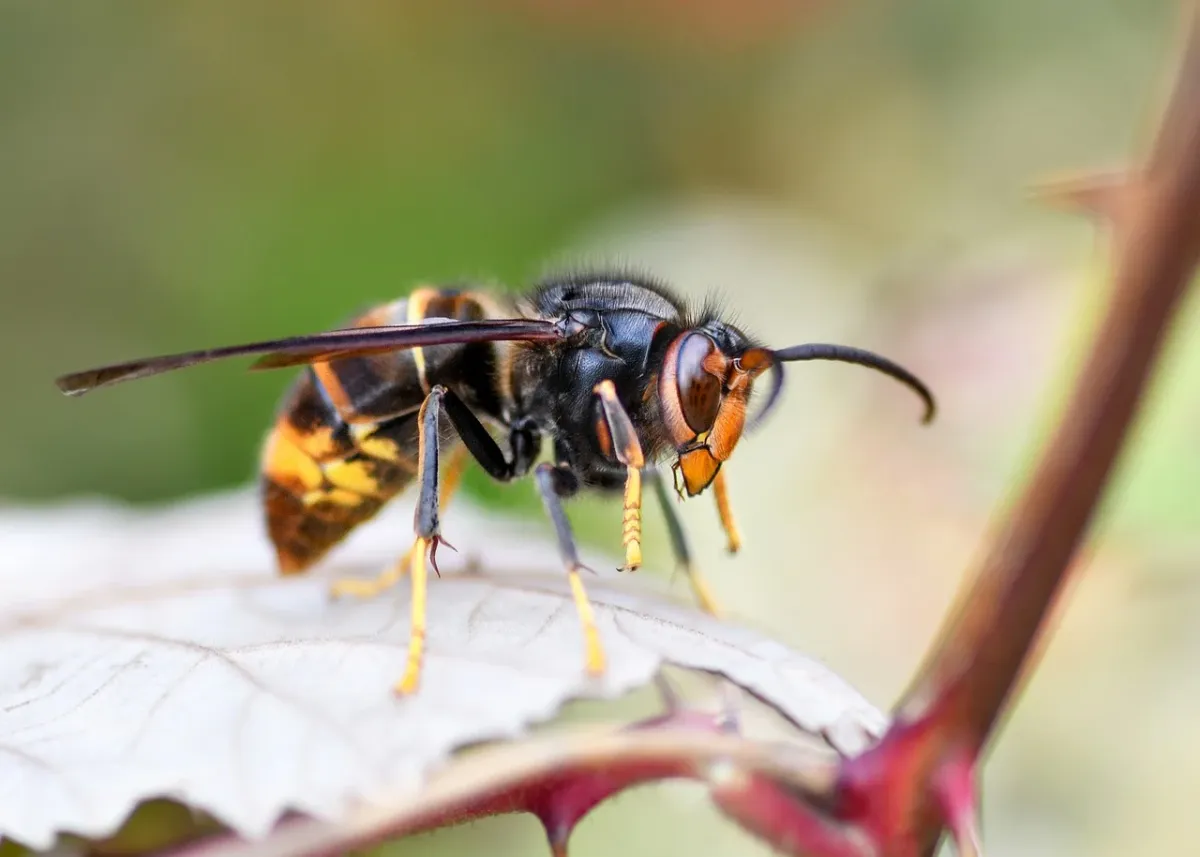
The yellow-legged hornet (YLH), also known as the Asian hornet (Vespa velutina nigrithorax), is an invasive predatory insect native to South-East Asia. It was first confirmed in Europe in Lot-et-Garonne, south-west France, in 2004, thought to have arrived in a consignment of pottery from China. The National Bee Unit (NBU) lists it as established in France, Spain, Portugal, Belgium, the Netherlands, Germany, Italy, Switzerland and Jersey.[5]
In September 2016 the first yellow-legged hornet nest in the UK was found at Tetbury in Gloucestershire.[6] Since then hornets have repeatedly reached the UK, for example in freight, on vehicles and blown across the Channel. Numbers vary sharply from year to year.
Whether the hornet is now established here is still being assessed. In 2024 the NBU said its findings were not strong evidence of an established population.[3] In March 2026, after kinship analysis of nests destroyed from 2016 to 2024, Defra and the NBU said the results suggest a limited established population in England, while remaining committed to finding and destroying nests.[7] Some beekeepers on the ground are sceptical that eradication alone will hold.
Unlike the native European Hornet (Vespa crabro), the yellow-legged hornet is a predator of honey bees and other pollinators. A single nest can contain several thousand workers, and its impact on local bee populations can be severe.
Know the Difference
Identification guide
The Asian Hornet is commonly confused with the native European Hornet and other species. Learn the key differences to report sightings accurately.
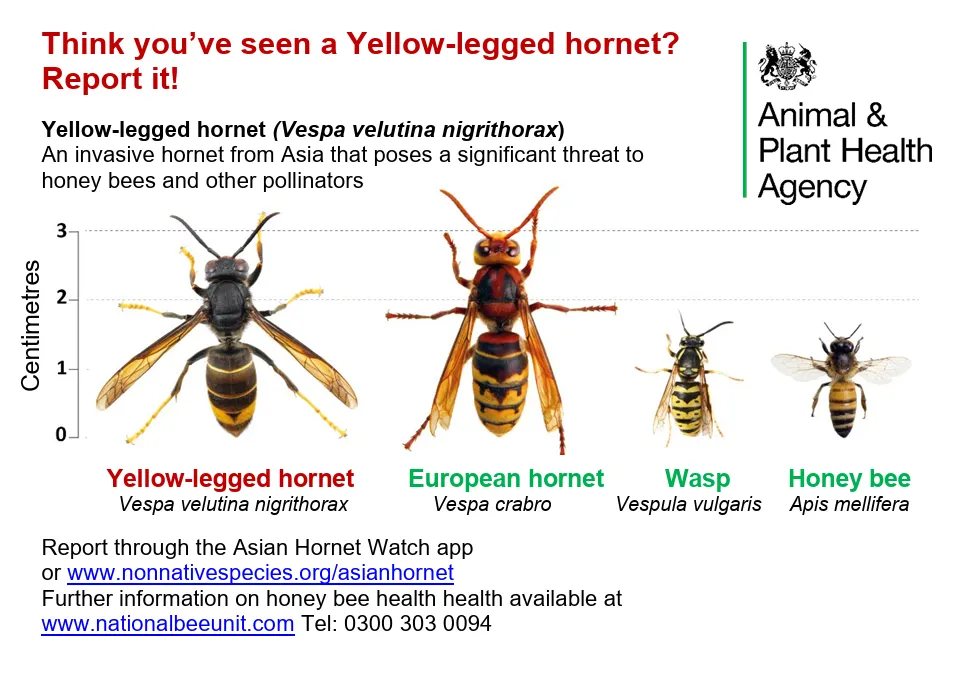
Asian Hornet
Vespa velutina
- Dark brown/black thorax and abdomen
- Distinctive yellow-tipped legs
- Orange face
- Mostly black abdomen with a single yellow band on the 4th segment
- Workers about 25mm long, queens up to 30mm
- Builds large nests high in trees
European Hornet
Vespa crabro
- Yellow and reddish-brown body
- Brown legs without yellow tips
- Yellow face
- Yellow bands on abdomen
- Workers about 30mm, queens up to 35mm — larger than the Asian Hornet
- Nests in hollow trees and sheltered spots
Common Wasp
Vespula vulgaris
- Bright yellow and black body
- Yellow legs
- Yellow face with anchor-shaped mark
- Distinct alternating black and yellow bands
- Workers 12–17mm — much smaller
- Builds nests underground or in cavities
Size and colour details: NBU[5]
The Danger
The threat to honey bees
Asian Hornets are specialist predators of honey bees, employing a hunting technique known as 'hawking'. They hover at the entrance of bee hives, ambushing returning forager bees in mid-flight. A single Asian Hornet can catch and kill dozens of honey bees in a single day to feed its developing colony.
The sustained predation pressure causes significant stress to bee colonies. Hives under attack reduce their foraging activity, leading to weakened colonies that are more vulnerable to disease and may fail to survive winter. In south-west France, where the hornet is now widespread, beekeepers have reported colony losses of 30–80%.[9]
Honey bees are not its only prey: it is a generalist predator that also takes flies, social wasps and other insects. A French diet study of 16 nests suggested a minor impact on wild species,[10] and research on baited traps found that non-selective traps catch far more native insects than hornets.[11] That is why BuzzCopper detects and alerts rather than kills.
Beyond the Hive
The wider impact
Beekeeping Industry
The UK had 257,976 managed honey bee colonies in the NBU's 2025 hive count (252,647 in 2024). Asian Hornet predation threatens both commercial and hobbyist beekeeping, with potential losses in honey production and pollination services.
Biodiversity & Ecology
Pollinators underpin ecosystem health. French diet studies suggest a minor impact on wild species, but the NBU notes a risk to invertebrate diversity where nests occur at high densities.
Food Security
Around one-third of UK food crops depend on insect pollination. The threat to pollinators from Asian Hornets has direct implications for agricultural productivity and food security.
Tracking the Spread
UK status & timeline
2016
First confirmed yellow-legged hornet nest found at Tetbury, Gloucestershire (found 19 September, destroyed 28 September) — the first known occurrence in the UK.[6]
2017–2022
Sporadic incursions across Britain: a likely queen at a distribution centre in Scotland (2017), single hornets in Lancashire and near Hull, East Yorkshire (2018), and nests in Devon, Cornwall, Hampshire, Staffordshire, Dorset, Berkshire and Essex, all destroyed by the National Bee Unit.[6]
2023
72 nests were found in 56 locations — an unprecedented year, mostly in Kent.[4]
2024
24 nests and 71 credible sightings (NBU, 19 November 2024).[3]
2025
163 nests and 544 credible sightings (NBU figures as of 5 January 2026; some press still says 161). Most were in the south-east, with nests further north too, such as Langton, North Yorkshire (27 August 2025).[2]
2026
As of 17 September 2026: 201 credible sightings and 66 nests, including Chadderton (Greater Manchester), two at Immingham (Lincolnshire) and an embryo nest at Chesterfield (Derbyshire). The first sighting of the year was at Doncaster on 24 February 2026, with no sample obtained.[1]
Take Action
What can you do?
Learn to Identify
Study the identification guide above — know the difference between the Asian Hornet, European Hornet, and common wasps. Accurate identification is the first step.
Monitor Your Area
Deploy a BuzzCopper device or set up bait stations to monitor for Asian Hornets in your garden or apiary, particularly from spring through autumn.
Report Sightings
If you suspect an Asian Hornet sighting, report it immediately via the official iOS app, Android app, or online reporting form. Include a photograph if possible.
Download the App
Use the free Asian Hornet Watch app (available on iOS and Android) to submit sightings with photographs directly to the Non-Native Species Secretariat.
Spread Awareness
Share information with fellow beekeepers, gardeners, and neighbours. The more people who can identify Asian Hornets, the faster they can be reported and nests destroyed.
Protect your pollinators — Detect. Alert. Act.
Useful Links
Official resources
-
National Bee Unit (NBU)
Asian Hornet information, identification, and reporting guidance
-
Non-Native Species Secretariat (NNSS)
Invasive species alerts, guidance, and policy
-
Asian Hornet Watch App (iOS)
Official iOS app for reporting Asian Hornet sightings
-
Asian Hornet Watch App (Android)
Official Android app for reporting Asian Hornet sightings
-
Online Reporting Form
Official web form for reporting Asian Hornet sightings
References
Sources
- [1] National Bee Unit (APHA), Yellow-legged hornet 2026 rolling update (figures as of 17 September 2026)
- [2] National Bee Unit (APHA), Yellow-legged hornet 2025 rolling update (figures as of 5 January 2026)
- [3] National Bee Unit (APHA), Asian hornet 2024 rolling update (figures as of 19 November 2024)
- [4] National Bee Unit (APHA), 2023 Asian hornet rolling updates
- [5] National Bee Unit (APHA), Yellow-legged hornet: background, appearance and European range
- [6] National Bee Unit (APHA), Historic UK yellow-legged hornet incursions, 2016–2022
- [7] National Bee Unit (APHA) / Defra Bee Health Policy Team, Yellow-legged hornet analyses (March 2026)
- [8] National Bee Unit (APHA), Hive count 2025 results
- [9] Requier et al. (2019), Vespa velutina: An alien driver of honey bee colony losses, Diversity 12(1):5
- [10] Rome et al. (2021), Not just honeybees: predatory habits of Vespa velutina in France, Annales de la Société entomologique de France 57(1)
- [11] Performance of baited traps used as control tools for the invasive hornet Vespa velutina and their impact on non-target insects, Apidologie (2018)